
Author name: mohdsheroof6501@gmail.com

Uncategorized

Ads Integrated Inside AI Search & Conversational Interfaces

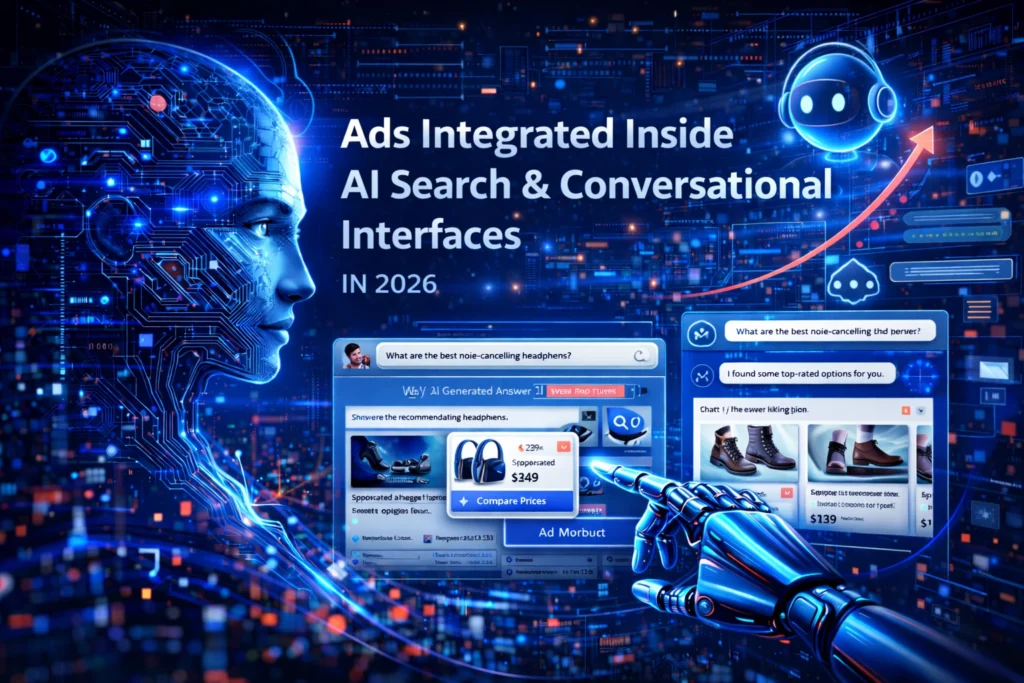
Ads Integrated Inside AI Search & Conversational Interfaces: The Future of Digital Advertising Digital advertising is entering a transformative phase as artificial intelligence reshapes how users search, interact, and make decisions online. By 2026, traditional search engine result pages are no longer the primary destination for user discovery. Instead, AI-powered search engines and conversational interfaces deliver direct answers, recommendations, and insights—often within a single, fluid interaction. In this new ecosystem, advertising has evolved from static placements into contextual, conversational, and AI-integrated experiences. Ads integrated inside AI search and conversational interfaces represent a fundamental shift in how brands reach audiences. Rather than interrupting the user journey, these ads are designed to blend seamlessly into AI-generated responses, offering value-driven, intent-aligned solutions at the exact moment users need them. The Evolution from Search Ads to AI-Integrated Ads For years, digital advertising revolved around keywords, bidding, and visible ad slots. Ads appeared above or alongside organic results, clearly separated from informational content. While effective, this model depended on users clicking links and navigating multiple pages. AI-powered search changes this entirely. Modern AI systems interpret intent, understand context, and generate synthesized responses that summarize the best available information. In many cases, users receive answers without ever clicking a website. This shift has given rise to zero-click experiences, where visibility matters more than traffic volume. To adapt, advertising has moved inside these AI-driven experiences. Ads are no longer just placements—they are recommendations, suggestions, and contextual enhancements within conversations. What Are AI Search & Conversational Interfaces? AI search and conversational interfaces include: AI-powered search engines that generate summaries and answers Conversational assistants embedded in search platforms Shopping and discovery chats driven by AI Voice assistants and multimodal AI interfaces These systems engage users through natural language, responding to questions like a human assistant would. Ads integrated into these environments must match this conversational tone while delivering relevance and trust. How Ads Are Integrated into AI Search Experiences 1. Contextual Recommendations Rather than showing a traditional ad, AI systems introduce sponsored content as contextual suggestions. For example, when a user asks about the best tools, services, or products, AI may recommend options that include paid placements—clearly labeled but naturally embedded within the response 2. Conversational Ad Placement In conversational interfaces, ads appear as part of the dialogue. Instead of banners or text ads, the AI might say: “Based on your needs, this solution could help,” followed by a sponsored recommendation. This format feels less intrusive and more helpful, increasing engagement and trust. 3. Personalized Ad Responses AI systems use behavioral data, preferences, and real-time context to deliver hyper-personalized ad experiences. Ads are tailored to: User intent Location Past interactions Device and time of day This makes ads feel relevant rather than generic. Why This Advertising Model Is Powerful Intent-Driven Exposure AI-integrated ads appear only when they are relevant to the user’s question or need. This reduces wasted impressions and increases conversion potential. Native & Non-Intrusive Because ads are embedded in AI-generated responses, they do not disrupt the user experience. Instead, they enhance it by offering solutions. Higher Trust & Credibility When AI systems recommend or reference a brand, users often perceive it as more credible than a traditional ad. Trust becomes a key performance factor. Impact on Advertisers and Brands Shift from Keywords to Context Advertisers must move beyond keyword targeting and focus on intent modeling, contextual relevance, and conversational alignment. Creative Optimization Ad creatives must be designed for conversation: Clear, concise messaging Value-focused copy Natural language tone Problem-solving approach Static ads give way to dynamic, AI-adaptable content. Measurement and Performance Metrics Traditional metrics like clicks and impressions are no longer enough. In AI-integrated advertising, success is measured by: Engagement within AI conversations Brand visibility in AI responses Assisted conversions Influence on decision-making Advertisers must adopt new attribution models that reflect AI-driven journeys. Challenges in AI-Integrated Advertising Transparency and Disclosure Clear labeling of sponsored content is essential to maintain trust. Users must know when a recommendation is paid. Brand Safety Ads must align with the AI’s tone, values, and context. Misalignment can harm brand perception. Reduced Control Advertisers give up some control to AI systems, making strategic input and high-quality data more important than manual adjustments. Opportunities for Early Adopters Brands that adapt early gain: First-mover advantage in AI environments Stronger brand authority and recall Higher-quality leads driven by intent Businesses that treat AI as a partner rather than a platform will outperform competitors. The Role of Google Ads and Other Platforms By 2026, platforms like Google Ads integrate deeply with AI search experiences. Ads appear within: AI-generated summaries Conversational shopping results Voice search answers Advertisers provide assets, data, and strategic goals, while AI systems determine placement, timing, and format. The Future of Advertising in AI Search The future of digital advertising is assistive, adaptive, and intent-led. AI search and conversational interfaces are redefining how users discover products and services. Ads will no longer compete for attention—they will earn relevance through usefulness. Brands that succeed will focus on: User-first value Authentic messaging Trust and transparency AI-aligned optimization strategies Conclusion Ads integrated inside AI search and conversational interfaces represent the next evolution of digital advertising. As AI becomes the primary gateway to information and discovery, advertising must evolve from interruption to assistance. In this new era, relevance outweighs reach, context matters more than clicks, and trust becomes the ultimate currency. For marketers, this shift is not a threat—it is an opportunity to build deeper, more meaningful connections with audiences by showing up exactly when it matters most.
Uncategorized

AI-Powered Search & Generative Engine Optimization

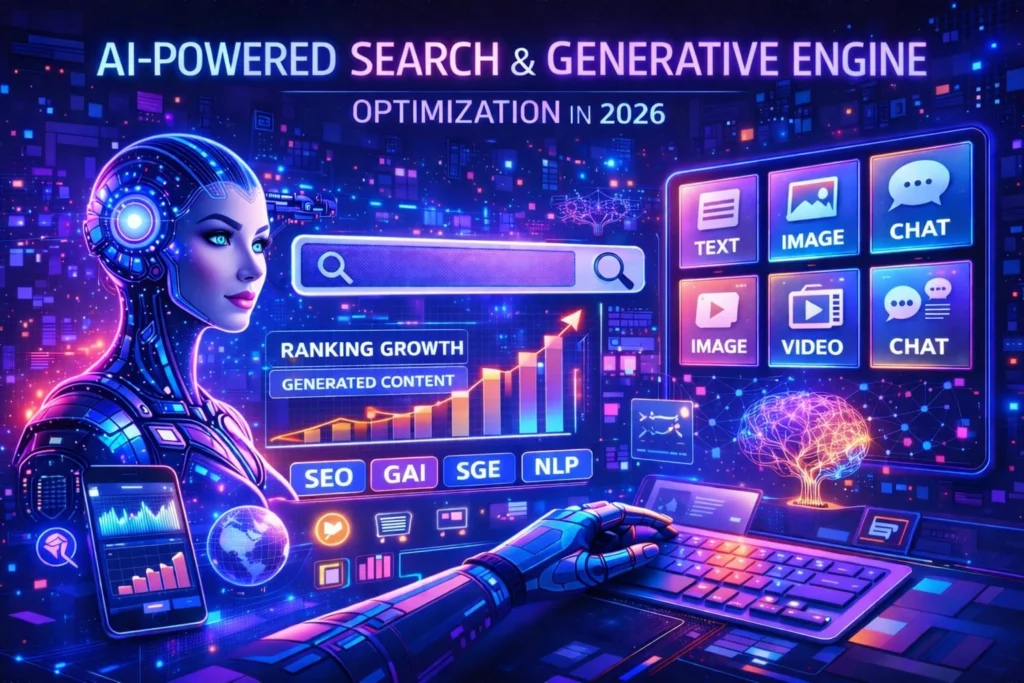
AI-Powered Search & Generative Engine Optimization (GEO): Redefining Digital Visibility The digital marketing landscape is undergoing one of its most significant transformations in decades. As artificial intelligence becomes deeply embedded in search technologies, traditional search engine optimization (SEO) is evolving into a new discipline known as AI-Powered Search and Generative Engine Optimization (GEO). By 2026, search is no longer just about ranking web pages—it’s about training AI systems to understand, trust, and surface your content as answers. This shift marks the beginning of a new era where visibility depends not only on keywords and backlinks, but on context, credibility, structured data, and semantic relevance. GEO represents how brands, creators, and businesses must adapt to remain discoverable in AI-driven search environments. The Rise of AI-Powered Search Traditional search engines were built around crawling, indexing, and ranking pages based on keywords, links, and user signals. While effective for years, this model is now being reshaped by generative AI systems that aim to provide direct, conversational answers instead of lists of blue links. AI-powered search engines analyze vast datasets, understand user intent, and generate synthesized responses in real time. Rather than sending users to multiple websites, these systems often summarize information, compare options, and deliver insights instantly. This fundamentally changes how users interact with search and how brands earn visibility. In this environment, ranking #1 is no longer the only goal. The real objective is to become a trusted source that AI engines cite, reference, or rely upon when generating answers. What Is Generative Engine Optimization (GEO)? Generative Engine Optimization (GEO) is the practice of optimizing content so it can be understood, trusted, and selected by AI systems that generate search responses. While SEO focuses on optimizing for algorithms that rank pages, GEO focuses on optimizing for AI reasoning and content synthesis. GEO ensures that content is: Structurally clear and machine-readable Contextually rich and semantically accurate Authoritative and verifiable Aligned with conversational and intent-driven queries Instead of optimizing for “clicks,” GEO optimizes for inclusion in AI-generated answers. How AI Understands Content Differently AI-powered search engines don’t simply scan for keywords. They evaluate content based on meaning, relationships, and credibility. This includes: Entity recognition (people, brands, locations, concepts) Topic depth and coverage Consistency across sources Factual accuracy Contextual relevance to user intent For example, rather than ranking a page because it repeats a keyword, AI assesses whether the content genuinely answers a question, explains a concept clearly, and aligns with verified knowledge. This means shallow, keyword-stuffed content loses relevance, while well-structured, expert-driven content gains authority. Key Components of GEO in 2026 1. Intent-First Content Strategy AI-powered search prioritizes user intent over keyword volume. Content must directly address: What users are asking Why they are asking What outcome they expect Optimized content anticipates follow-up questions and provides comprehensive answers, making it more useful to AI systems. 2. Structured & Semantic Content Clear structure helps AI systems parse and understand information. This includes: Logical headings and subheadings Bullet points and summaries Schema markup and structured data Clear definitions and explanations Structured content improves the chances of being selected for AI-generated responses. 3. Authority, Trust & Expertise AI engines prioritize trustworthy sources. Brands must demonstrate: Subject-matter expertise Consistent publishing quality Transparent authorship Accurate and up-to-date information This aligns closely with principles like Experience, Expertise, Authority, and Trustworthiness (E-E-A-T), which remain central in AI-driven search. 4. Conversational & Natural Language Optimization As voice search and conversational AI grow, content must sound natural and human. Optimizing for: Question-based queries Conversational phrasing Long-tail, intent-driven prompts helps content match how users actually interact with AI systems 5. Zero-Click & Answer-Based Visibility In many AI-powered searches, users get answers without clicking a website. While this reduces traditional traffic, it increases brand exposure, credibility, and authority. Successful GEO strategies measure impact through: Brand mentions in AI outputs Visibility across AI summaries Authority signals rather than just clicks The Impact on Digital Marketing AI-Powered Search and GEO reshape every aspect of digital marketing: Content marketing shifts from volume to depth and clarity SEO strategies evolve into AI visibility frameworks Brand trust becomes as important as rankings Analytics move beyond clicks to influence and reach Marketers must think less like keyword optimizers and more like knowledge architects, creating content ecosystems that AI systems can rely on. Challenges and Opportunities While GEO presents challenges—such as reduced website traffic and changing metrics—it also opens new opportunities: Becoming a recognized authority in your niche Gaining exposure through AI-generated recommendations Reaching users earlier in the decision-making journey Brands that adapt early gain a competitive advantage, while those relying solely on traditional SEO risk invisibility. The Future of Search Visibility By 2026 and beyond, search will be predictive, conversational, and AI-mediated. Users will rely on AI not just to find information, but to interpret, compare, and recommend. In this world, Generative Engine Optimization is no longer optional—it’s essential. The brands that succeed will be those that focus on value, clarity, trust, and relevance, building content designed not just to rank, but to teach, guide, and inform AI systems. Conclusion AI-Powered Search & Generative Engine Optimization represent a fundamental shift in how digital visibility works. As search engines become intelligent answer engines, marketers must evolve from optimizing pages to optimizing knowledge. GEO is the bridge between human expertise and machine intelligence, ensuring that high-quality content remains visible, influential, and trusted in an AI-driven future. In the new era of digital marketing, those who help AI understand the world will shape how the world discovers brands.

Uncategorized

AI-Driven Search & Content Visibility

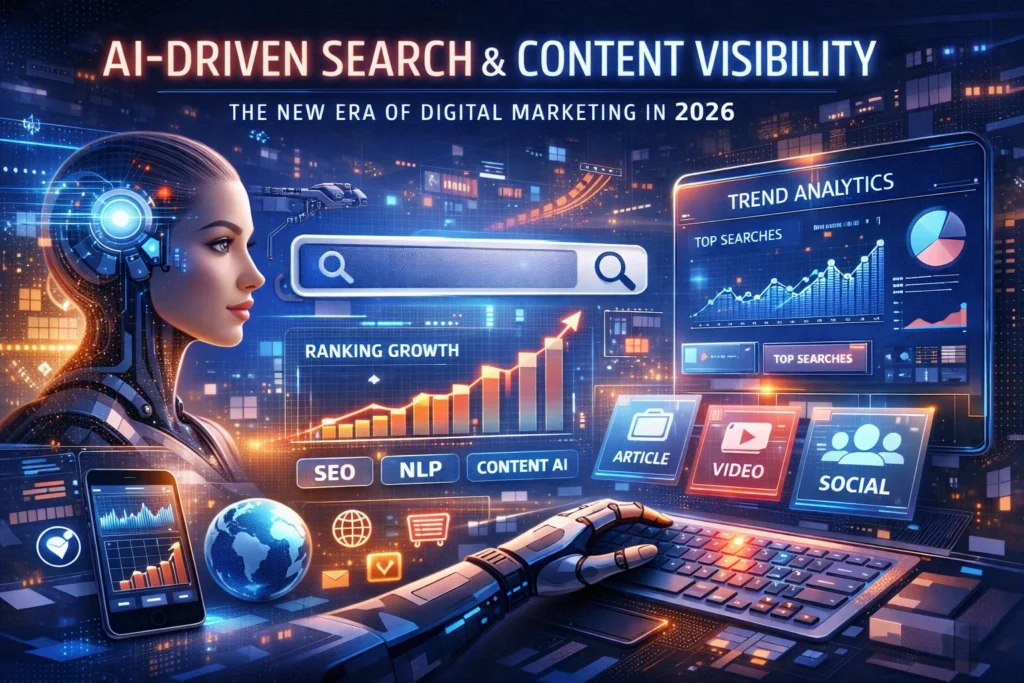
AI-Driven Search & Content Visibility: The New Era of Digital Marketing in 2026 AI-driven search is no longer a future concept — it’s the reality shaping how people discover content in 2026. Traditional SEO, once dominated by keywords, backlinks, and rankings, has evolved into something far more dynamic, conversational, and intent-driven. Today, search engines and AI assistants don’t just index content — they interpret, summarize, and recommend it. This shift has fundamentally changed how brands compete for visibility online. Success is no longer just about ranking on page one; it’s about being chosen by AI as a trusted source of information. In this article, we’ll explore what AI-driven search really means, how it impacts content visibility, and what marketers must do to stay relevant in this new landscape. What Is AI-Driven Search? AI-driven search refers to search experiences powered by artificial intelligence models that understand context, intent, and natural language. Instead of returning a list of blue links, modern search engines and AI tools now generate direct answers, summaries, and recommendations. Examples include: AI search overviews in search engines Conversational AI assistants Voice search and multimodal queries (text, image, voice) Users are increasingly asking full questions like: “What’s the best digital marketing strategy for SaaS startups in 2026?” Rather than scanning multiple websites, they receive one synthesized answer — often without clicking through to a page. This behavior marks a massive shift in how content is discovered and consumed. Why Content Visibility Looks Different in 2026 From Rankings to Recommendations In the past, ranking #1 on Google was the ultimate goal. Today, AI systems act as gatekeepers, deciding which sources are credible enough to be referenced or summarized. Visibility now means: Being cited in AI-generated answers Being surfaced in conversational responses Being trusted as an authoritative source If your content isn’t structured, clear, and authoritative, it may never be seen — even if it technically “ranks.” The Rise of Zero-Click and AI Answers One of the biggest challenges marketers face is the rise of zero-click searches, where users get answers instantly without visiting a website. While this reduces traditional traffic, it increases the importance of: Brand mentions Thought leadership visibility Content authority In 2026, influence matters as much as clicks. How AI Evaluates Content Visibility AI systems don’t think like humans, but they evaluate content using signals that closely resemble human judgment. Key factors include: 1. Topical Authority AI favors content that demonstrates deep expertise on a subject rather than surface-level coverage. Brands that consistently publish high-quality content within a niche are more likely to be trusted. 2. Contextual Relevance Instead of matching exact keywords, AI looks at: User intent Semantic meaning Related concepts This means content should be written for humans first, not search engines. 3. Clarity and Structure Well-organized content with: Clear headings Concise explanations Logical flow is easier for AI to interpret and summarize accurately. 4. Trust Signals AI models evaluate: Accuracy Consistency Brand reputation Author expertise Content that feels vague, overly promotional, or misleading is far less likely to be surfaced. The Evolution of SEO in an AI-Driven World Keyword SEO vs. Intent SEO Keywords still matter, but they’re no longer the foundation. In 2026, SEO focuses on: Search intent User questions Problem-solution alignment Instead of optimizing for “AI search trends,” successful content answers: “What problem is the user trying to solve?” Conversational Content Is Now Essential People talk to AI the way they talk to humans. That means content should reflect: Natural language Clear explanations Conversational tone Content that sounds robotic or over-optimized often performs worse in AI-driven environments. AI-Humanized Content: The New Gold Standard AI-humanized content blends strategic optimization with authentic human expression. This type of content: Sounds natural and empathetic Uses real examples and insights Avoids generic, template-style writing Ironically, as AI becomes more advanced, human authenticity becomes more valuable. Brands that succeed in AI-driven search don’t just publish content — they communicate ideas, perspectives, and expertise. Final Thoughts: Winning in AI-Driven Search AI-driven search isn’t killing SEO — it’s evolving it. The brands that win in 2026 are the ones that understand this shift and embrace it. To stay visible: Write for humans, not algorithms Build real topical authority Focus on clarity, trust, and usefulness Treat AI as a curator, not an enemy In the age of AI-driven search, the most powerful strategy is simple: Create content that genuinely deserves to be seen.

Scroll to Top