
AI-Powered Search & Generative Engine Optimization (GEO): Redefining Digital Visibility
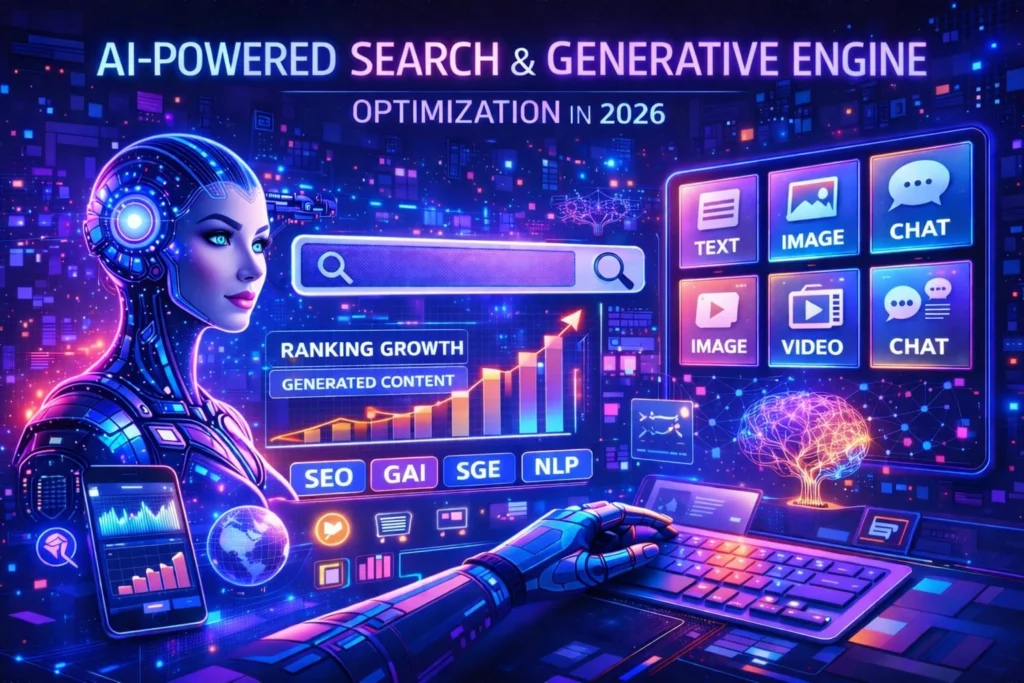
The digital marketing landscape is undergoing one of its most significant transformations in decades. As artificial intelligence becomes deeply embedded in search technologies, traditional search engine optimization (SEO) is evolving into a new discipline known as AI-Powered Search and Generative Engine Optimization (GEO). By 2026, search is no longer just about ranking web pages—it’s about training AI systems to understand, trust, and surface your content as answers.
This shift marks the beginning of a new era where visibility depends not only on keywords and backlinks, but on context, credibility, structured data, and semantic relevance. GEO represents how brands, creators, and businesses must adapt to remain discoverable in AI-driven search environments.
The Rise of AI-Powered Search
Traditional search engines were built around crawling, indexing, and ranking pages based on keywords, links, and user signals. While effective for years, this model is now being reshaped by generative AI systems that aim to provide direct, conversational answers instead of lists of blue links.
AI-powered search engines analyze vast datasets, understand user intent, and generate synthesized responses in real time. Rather than sending users to multiple websites, these systems often summarize information, compare options, and deliver insights instantly. This fundamentally changes how users interact with search and how brands earn visibility.
In this environment, ranking #1 is no longer the only goal. The real objective is to become a trusted source that AI engines cite, reference, or rely upon when generating answers.
What Is Generative Engine Optimization (GEO)?
Generative Engine Optimization (GEO) is the practice of optimizing content so it can be understood, trusted, and selected by AI systems that generate search responses. While SEO focuses on optimizing for algorithms that rank pages, GEO focuses on optimizing for AI reasoning and content synthesis.
GEO ensures that content is:
- Structurally clear and machine-readable
- Contextually rich and semantically accurate
- Authoritative and verifiable
- Aligned with conversational and intent-driven queries
Instead of optimizing for “clicks,” GEO optimizes for inclusion in AI-generated answers.
How AI Understands Content Differently
AI-powered search engines don’t simply scan for keywords. They evaluate content based on meaning, relationships, and credibility. This includes:
- Entity recognition (people, brands, locations, concepts)
- Topic depth and coverage
- Consistency across sources
- Factual accuracy
- Contextual relevance to user intent
For example, rather than ranking a page because it repeats a keyword, AI assesses whether the content genuinely answers a question, explains a concept clearly, and aligns with verified knowledge.
This means shallow, keyword-stuffed content loses relevance, while well-structured, expert-driven content gains authority.
Key Components of GEO in 2026
1. Intent-First Content Strategy
AI-powered search prioritizes user intent over keyword volume. Content must directly address:
- What users are asking
- Why they are asking
- What outcome they expect
Optimized content anticipates follow-up questions and provides comprehensive answers, making it more useful to AI systems.
2. Structured & Semantic Content
Clear structure helps AI systems parse and understand information. This includes:
- Logical headings and subheadings
- Bullet points and summaries
- Schema markup and structured data
- Clear definitions and explanations
Structured content improves the chances of being selected for AI-generated responses.
3. Authority, Trust & Expertise
AI engines prioritize trustworthy sources. Brands must demonstrate:
- Subject-matter expertise
- Consistent publishing quality
- Transparent authorship
- Accurate and up-to-date information
This aligns closely with principles like Experience, Expertise, Authority, and Trustworthiness (E-E-A-T), which remain central in AI-driven search.
4. Conversational & Natural Language Optimization
As voice search and conversational AI grow, content must sound natural and human. Optimizing for:
- Question-based queries
- Conversational phrasing
- Long-tail, intent-driven prompts
helps content match how users actually interact with AI systems
5. Zero-Click & Answer-Based Visibility
In many AI-powered searches, users get answers without clicking a website. While this reduces traditional traffic, it increases brand exposure, credibility, and authority.
Successful GEO strategies measure impact through:
- Brand mentions in AI outputs
- Visibility across AI summaries
- Authority signals rather than just clicks
The Impact on Digital Marketing
AI-Powered Search and GEO reshape every aspect of digital marketing:
- Content marketing shifts from volume to depth and clarity
- SEO strategies evolve into AI visibility frameworks
- Brand trust becomes as important as rankings
- Analytics move beyond clicks to influence and reach
Marketers must think less like keyword optimizers and more like knowledge architects, creating content ecosystems that AI systems can rely on.
Challenges and Opportunities
While GEO presents challenges—such as reduced website traffic and changing metrics—it also opens new opportunities:
- Becoming a recognized authority in your niche
- Gaining exposure through AI-generated recommendations
- Reaching users earlier in the decision-making journey
Brands that adapt early gain a competitive advantage, while those relying solely on traditional SEO risk invisibility.
The Future of Search Visibility
By 2026 and beyond, search will be predictive, conversational, and AI-mediated. Users will rely on AI not just to find information, but to interpret, compare, and recommend. In this world, Generative Engine Optimization is no longer optional—it’s essential.
The brands that succeed will be those that focus on value, clarity, trust, and relevance, building content designed not just to rank, but to teach, guide, and inform AI systems.
Conclusion
AI-Powered Search & Generative Engine Optimization represent a fundamental shift in how digital visibility works. As search engines become intelligent answer engines, marketers must evolve from optimizing pages to optimizing knowledge. GEO is the bridge between human expertise and machine intelligence, ensuring that high-quality content remains visible, influential, and trusted in an AI-driven future.
In the new era of digital marketing, those who help AI understand the world will shape how the world discovers brands.